Over nine months this has added up to more than 50,000 organic streams on SoundCloud and more than 600,000 views on TikTok, on a few euros of ad spend a day. One AI artist, built out of prompts and out of me.
The traditional route to a release: book studio time, pay a producer for the beat, hire a singer, commission cover art, shoot a music video, then marketing — and everyone takes a cut. Thousands of euros and months of work for one single, before anyone has heard it.
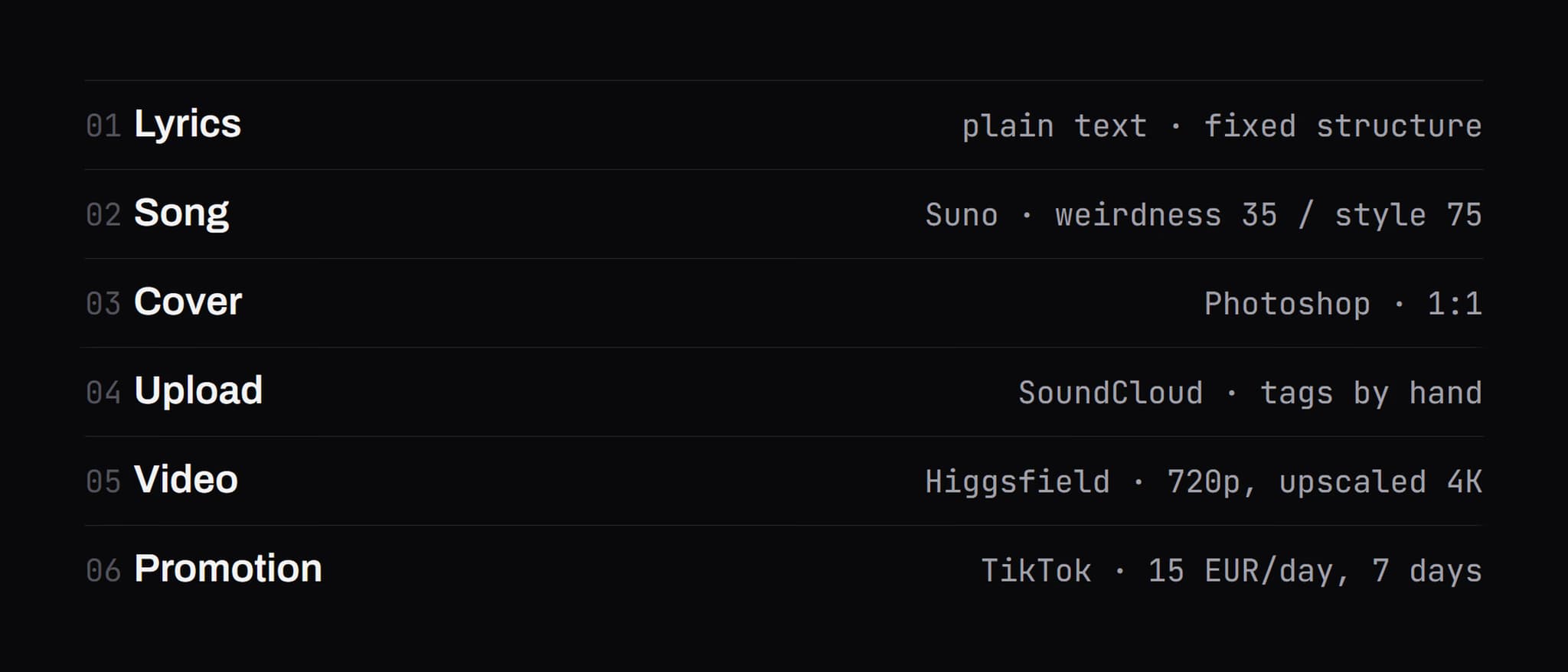
The text below is my pipeline to read: six phases, the same ones on every release. Worked through on my track Okean, under the artist name Desetka.
The tools
| Tool | For | Note |
|---|---|---|
| Suno | The song | Pro or Premier. Needed for commercial rights and the higher output quality. |
| Claude | Prompts, cover concept, descriptions and tags | |
| Higgsfield | Images and video generation | Ultra plan. |
| Photoshop | The cover template | So every release keeps the same format. |
| Premiere | The final cut |
Phase 1 · Lyrics
I write everything in a plain text editor first. No tools, no templates, just an empty file — but always the same structure:
[Instrumental Intro]
[Hook]
[Verse 1]
[Pre-Hook]
[Hook]
[Verse 2]
[Pre-Hook]
[Hook]
[Instrumental Outro]
Why this structure: it gives the song a shape before a single note exists. The hook repeats — that is what people remember. The verses carry the story. The pre-hook builds the tension right before the drop.
Every section is tagged in square brackets, because Suno reads those tags. On top of that go delivery notes I set almost every time — hypnotic melodic delivery, for instance. That is the extra information about how the song should sound, not only what is in it.
On Okean the lyrics are in Serbian, and the hook sets the mood for everything after it. It is a heartbreak song, heavy on purpose.
Phase 2 · The song
There are two routes, and I almost always take the second.
The fast route. Paste the lyrics, add a style prompt, generate the whole song. It works, and it is the route with the least control.
The route through the instrumental. Generate the instrumental first, with the styles the finished song should sound like. A pure focus prompt for the mood. Under "More Options" I set:
- Weirdness: 35
- Style influence: 75
Then I keep generating until the beat actually hits. Only once the instrumental is right does Suno's cover function come in: the version I liked, run again with the lyrics as revised by then.
The iteration
This is the part nobody sees from the outside. On Okean I was not happy with the pronunciation of certain words, or with the hook itself. The way through was: iterate repeatedly, carrying only 25 per cent audio reference from the previous version each time, and cover every pass again. And again. Until it sits.
Then one last round at normal variation strength as a remaster. Between the first generation and the final version there are double-digit numbers of takes — different styles, different pronunciations, different flows.
Phase 3 · Cover
On Pinterest I am not looking for a cover. I am looking for a feeling: light, colour, mood. A few images that match the song get saved.
To keep the artist's look consistent, everything then runs through the same Photoshop template: crop to 1:1, copy into the cover project, centre it, adjust curves and colour if needed. Export as PNG.
Where it failed
The attempt to generate the cover entirely in Higgsfield instead is in the video — and it failed. I am writing that down here on purpose, because runs like this are usually the part that gets cut out of a tutorial.
The approach: find an image on Pinterest, ask Claude to write a very detailed prompt from it, and run that in Higgsfield on Nano Banana Pro or Nano Banana 2, at 4K, 9:16 for the vertical format.
What happened:
- First four images — wrong perspective, wrong outfit.
- Screenshot of those back to Claude, with the instruction to correct the prompt and respect the reference person. New prompt, four more images.
- The model stayed glued to the reference image. Unusable.
- Switched from Nano Banana 2 to Nano Banana Pro. Same problems.
What did work in the end was a different route: hand Claude the lyrics and let it write a prompt that suits the mood of the track — instead of trying to reconstruct an image found somewhere else. That image went through the same Photoshop template and became the cover.
The lesson is unglamorous and holds anyway: reconstructing an image you saw somewhere is a much harder task than generating an image that matches a text you have.
Phase 4 · Upload
Before publishing, the track needs a description and tags. Both come out of a Claude chat set up as a template: an already published song with its description and tags as the example, then the new lyrics and a request for the same.
Anyone rebuilding this sets that one chat up once — with their own song names, tags and styles as the pattern — and uses it for every release afterwards.
The SoundCloud upload itself is straightforward: upload the track, title, link, main artist, genre. The tags have to be typed in one at a time, which is the most tedious part of the whole workflow. Then the description and the artwork.
Two things worth knowing:
- Releases can be scheduled rather than going live immediately.
- With SoundCloud Pro the audio file can be replaced later without losing the statistics. Streams, comments and reactions stay attached to the track. So if you are still working towards a final version, you can publish and improve it afterwards.
Phase 5 · Video
On TikTok it is not the song that moves, it is the picture. The starting point is the cover, or Pinterest again.
The simple route in Higgsfield: open video generation, pick the 3D renderer preset with Seedance 2.0 fast, upload one image — and that is it. No prompt. 720p, seven seconds, 9:16, about 30 generation tokens. The rest is trial and error: sometimes it takes several attempts before one is worth keeping.
Then comes the step that makes the difference: upscaling. Higgsfield uses Topaz Labs plugins for it. Settings 4K, 60 FPS, slow motion times 1, about 28 credits per video. 720p at 30 frames a second turns into something noticeably smoother.
So my order is: cut at 720p (Premiere), export, then upscale, then lay the track underneath. Not the other way round.
For more involved clips there is the Cinema Studio section: three reference images, a prompt from Claude for smooth transitions, output at 1080p and 9:16. I made a mistake there that is visible in the finished video — I had the start and end frames the wrong way round and reversed the result afterwards. That is why some of the motion looks off.
The canvas is useful too: one collection point per project. Download an image from Pinterest, hand it to Claude, have the prompt extracted from it, put the prompt on the canvas next to the image. That grows a personal stock of prompts that have already produced something usable.
Phase 6 · Ads
Releases go out on SoundCloud and TikTok. Promotion runs on TikTok, on very small amounts.
The settings I run:
- Objective: more video views
- Audience: Serbia, Croatia, Bosnia, ages 18 to 34
- Budget: about 15 euros a day over seven days
Germany is not the right audience for this material, because the lyrics are Serbian. Around 10 euros brings roughly 10,000 to 15,000 views. One video reached about 30,000 for the same spend because it went viral — that is the outlier, not the rule.
One detail I had underestimated: the video was obviously AI-generated and I had not labelled it as such. Reach was restricted as a result. The ads are what brought it back.
What is missing
Releasing to Spotify and YouTube Music currently fails because the music is AI-generated. That is an open problem, not a solved one.
The route I am working on: pull stems out of Suno, produce melodies and vocals there, and build the rest in a digital audio workstation. I write the lyrics myself anyway, with no AI involved, and there are many iterations between the first generation and the final version. The human part is there — it just has to exist in a form the distribution channels will accept.
Takeaway
Once the pipeline stands, every release is the same six steps: lyrics, song, cover, upload, video, promotion. The tools can change, the order stays. You build the structure once and ship finished, promoted tracks on repeat.
A studio, a label or a film crew is no longer required for that. What is required is a process — and the patience to iterate. The cover for Okean exists after four failed attempts.