Most people treat their LinkedIn profile like a business card: fill it out once, maybe while job hunting, and forget it the moment a contract is signed. That is backwards. The profile nobody has touched in two years is exactly the one that fails on the day it is needed.
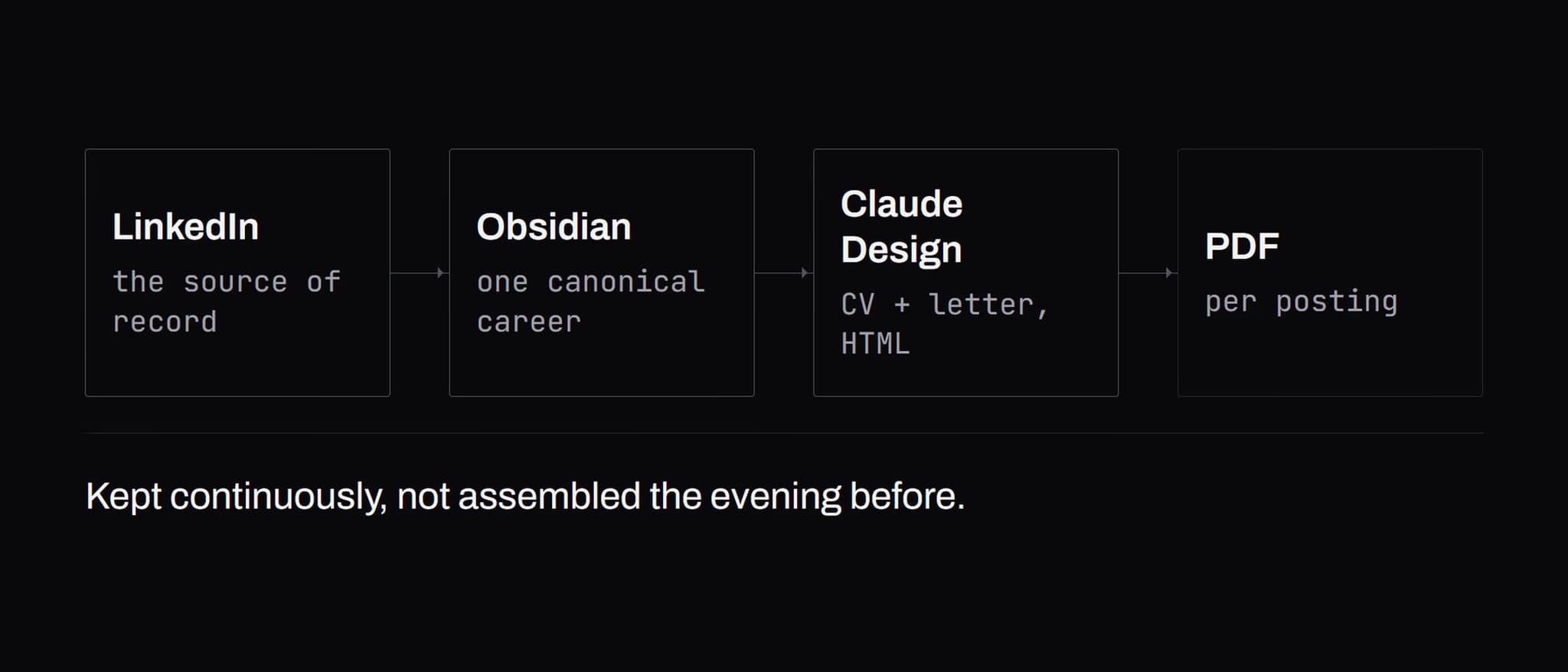
This video shows the workflow that turns "I need to apply" into a finished, tailored CV and cover letter in minutes rather than an evening. It stands on three things: LinkedIn, Obsidian and Claude.
LinkedIn as source
Every position needs real detail, not just a job title. What the responsibility was, which stack, what came out of it. A role that does not say what you built and with what is not working for you.
Two fields are routinely underrated:
- Skills. This is literally the field recruiters filter and search by. You can have remarkable experience and still be invisible to the exact search that would have found you, if this section is thin.
- Education. Do not leave it as a one-liner. What is written there is part of the same search profile.
The point of this is not how the page looks. The point is that it becomes a second brain instead of a document you rebuild from memory every time you apply somewhere.
The gap question
Once the profile stands, I go through it with Claude and ask something very simple:
This is my complete LinkedIn profile. What is missing? What else would you
need to know about me to understand my career?
That reliably catches things I would not have thought of myself: a project I undersold, a skill I forgot to mention, context that explains a gap in the timeline.
Everything consolidated goes into Obsidian: one canonical, complete version of my career that I keep updated, instead of reconstructing it on every application.
The shell
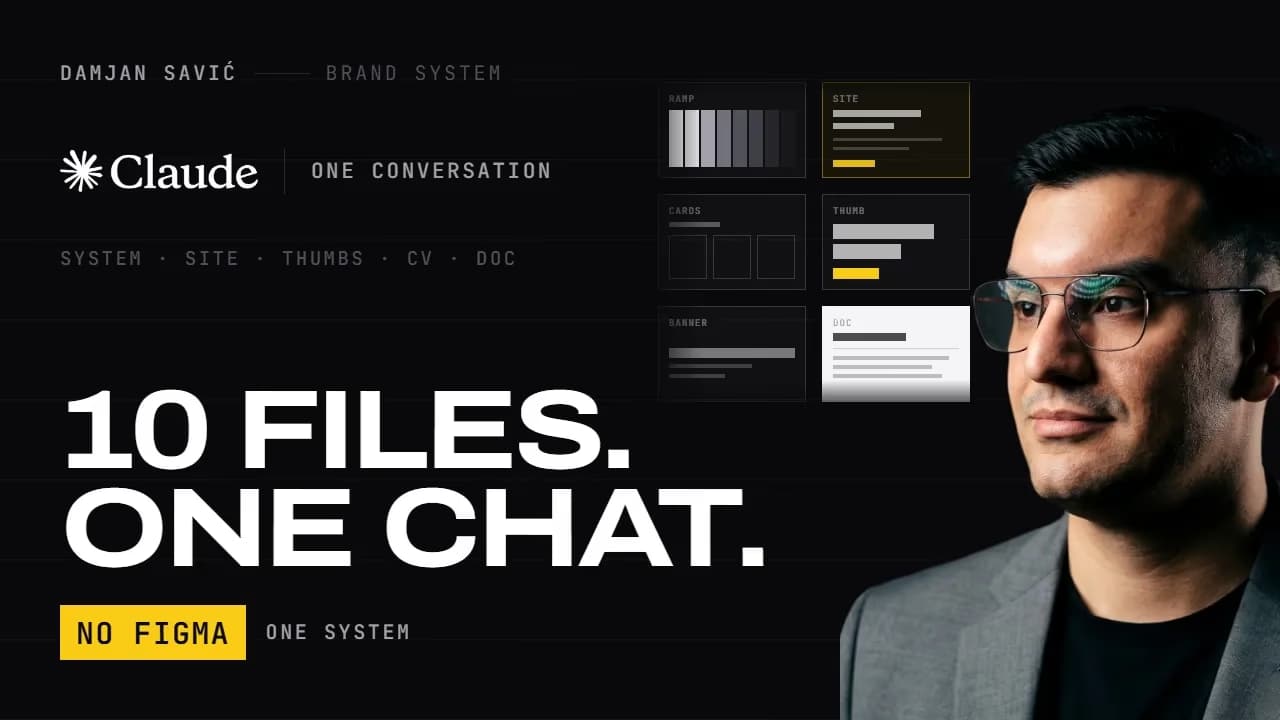
The reusable part is made in Claude Design. This is not a Word template with placeholder text — it is a real layout as HTML, one you control completely, built through conversation.
I started by attaching a screenshot of my LinkedIn profile. Claude reported that the resolution was too low to read the text, so I pasted the full content in as text instead. That is the kind of pushback you want: a question is better than a CV guessed out of a blurry image.
What I specified for the shell:
- Two templates in the same design language — one for the CV, one for the cover letter
- Output as HTML files, so they can serve as a template for variations
- Accent colour red
- Include a headshot
- Sans-serif throughout, so it reads quiet and current
I used Claude Sonnet 5 with effort set to high for it. The result was a two-page CV and a cover letter in the same language — and I had to design both exactly once.
The workflow
From here on, every application is the same short route:
- Find a posting.
- Hand the full text of the posting to Claude.
- Claude writes the cover letter in the existing template and adjusts what the CV emphasises.
- Export as PDF.
Write a cover letter tailored to this posting, using the template generated
earlier:

[full text of the posting]
This is exactly where it differs from a mail merge: the letter speaks to the posting directly, instead of being a generic one with the company name swapped in.
An example
The posting was for a software engineer role and named Python. I do not work with Python much; React is my daily driver on the front end, and my stack revolves around Next.js, TypeScript and Tailwind.
The right handling is neither hiding it nor claiming otherwise. You point at the experience that does exist with Python and React, and let the centre of gravity stay visible where it actually is. What a tailored CV can do is weighting — not invention.
Two last moves
For the signature I used a font of my own: hand Claude the OTF file, and it is available in the document afterwards.
For export there are two routes. Download it straight as a PDF through "Share" — or, on Windows, print the HTML file to PDF with Ctrl + P.
What keeps running
A workflow is only as good as what feeds it. So three things run continuously:
- Update LinkedIn at least once a month. Not only when you are looking.
- Keep the CV current. Not the version from two jobs ago plus a few edits.
- Stay in a loose, ongoing conversation with recruiters in your field. They get paid when they place someone. Staying visible to them costs you nothing, and every so often they put something in front of you that you would never have found on your own.
Readiness
That is what it comes down to: it is not a system for looking for work, it is a system for being ready.
The actual work — writing, maintaining, staying in touch — happens continuously, in small pieces. So that on the day a finished application is needed, you are not starting cold.
And that day arrives without warning: a layoff, a restructuring, a role that simply is not it any more. If your situation changes overnight, you are not sitting there trying to remember what you did three years ago. The relationships, the templates and the process are already there.
The difference in the conversation afterwards is considerable. You walk in with "I have options", not with "I need this".